
Texas Traffic Court Records
Texas traffic court records are public documents you can search and access from Justice of the Peace courts, municipal courts, and county courts across all 254 counties. Whether you need to look up a citation, check a case status, or get a copy of a judgment, this guide covers how to find Texas traffic court records using official state portals and local court offices. Most basic case information is free to search online through re:SearchTX and county court portals.
Texas Traffic Court Records Overview
How Texas Traffic Court Records Work
Traffic cases in Texas go through one of two types of courts depending on where and how the violation occurred. Justice of the Peace courts handle most traffic tickets issued outside city limits, in unincorporated areas, and on state roads. Municipal courts handle tickets issued within city limits. Both are courts of record in Texas, and both produce case files, judgments, and payment histories that can be searched by the public.
The Texas Judicial Branch oversees the entire court system, including JP courts and municipal courts. Each county has at least one Justice of the Peace, and most have several based on population size. Large counties like Harris and Dallas have dozens of JP precincts and municipal courts combined. Small counties may have just one JP who handles all traffic cases for the area. Understanding which court has your case is the first step toward finding the right record.
Texas has over 1,200 municipal courts and more than 800 JP courts statewide. That is a lot of places to look. The statewide re:SearchTX portal helps narrow it down by letting you search across all 254 counties at once.
Search Texas Traffic Records Online
The re:SearchTX statewide case search portal is the main tool for finding Texas traffic court records online. It covers courts across all 254 counties and lets you search by party name, case number, or court type. Account setup is free. Some document downloads require a small fee, but basic case index information costs nothing to view.
The re:SearchTX portal shows party names, case type, filing date, case status, hearing dates, and docket entries. It covers documents accepted through the eFile system. Keep in mind that re:SearchTX provides an unofficial copy of case information. The clerk of the court is the official custodian of court records. Data refreshes nightly, so very recent filings may not appear right away. For an official copy of any document, you need to contact the court clerk directly.
The Texas Judicial Branch appellate case search covers the Supreme Court, Court of Criminal Appeals, and all 14 Courts of Appeals. That system does not hold trial court records. For traffic cases, use re:SearchTX, not the appellate search.
Note: re:SearchTX data is not real-time. It refreshes nightly and may not reflect same-day case activity. For certified copies, contact the JP or municipal court clerk directly.
The Texas Judicial Branch website links to all courts in the state, including contact information for individual JP courts and municipal courts. If re:SearchTX does not have the county you need, the Judicial Branch site can point you to the specific court.
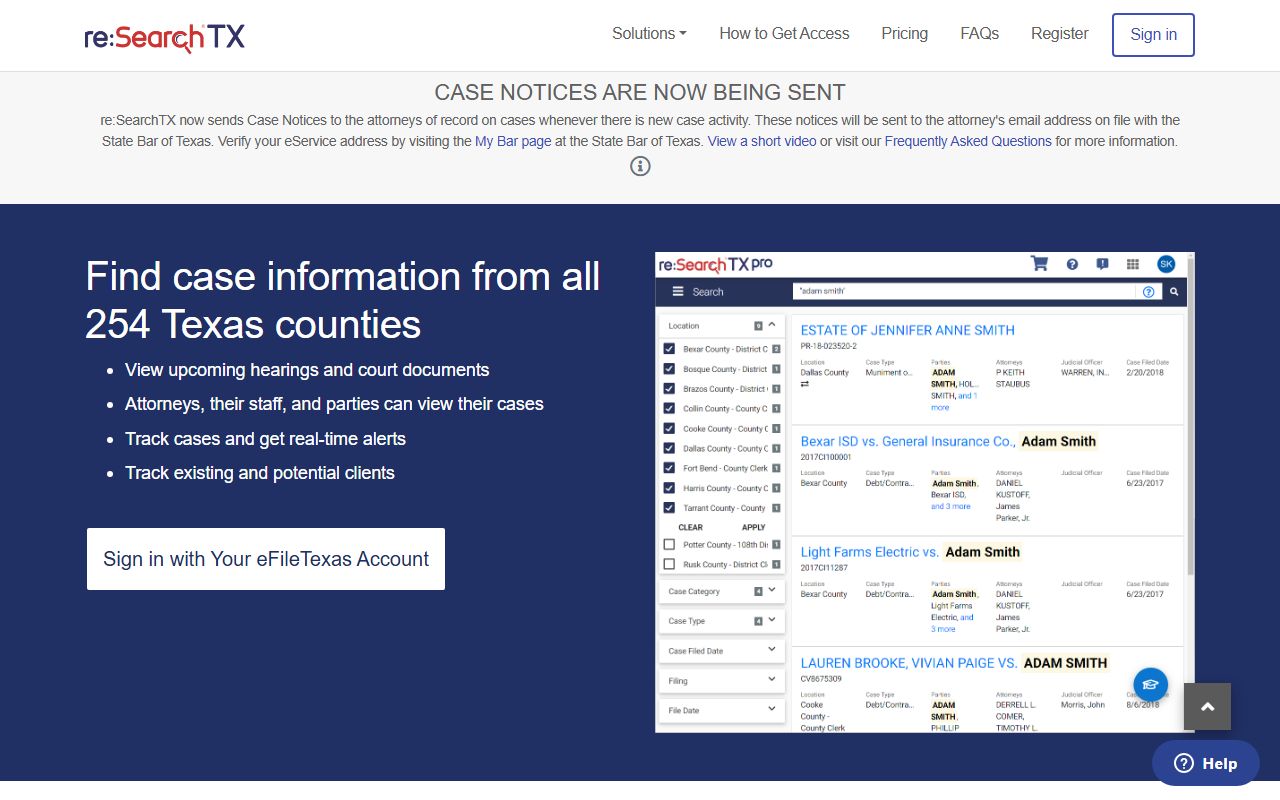
The re:SearchTX portal lets you search traffic case records from all 254 Texas counties using a party name or case number.
Texas Traffic Court Records by Violation Type
Traffic violations in Texas range from minor infractions to serious criminal offenses. The type of violation determines which court handles it and what kind of record it produces. Most tickets are Class C misdemeanors, which are the lowest level of criminal offense in Texas and carry fines but no jail time. These are handled by JP courts and municipal courts.
Common violations that produce traffic court records in Texas include speeding, running red lights, failure to stop at stop signs, improper lane changes, cell phone use while driving, failure to wear a seat belt, and expired registration or insurance. Under Transportation Code Chapter 545, the rules for operation of vehicles cover everything from lane use to following distance to reckless driving. Violations of Chapter 545 make up a large share of traffic court filings across the state.
More serious traffic offenses go to county courts or district courts. Driving while intoxicated (DWI) is a Class B misdemeanor at minimum under Texas law. Repeat DWI offenses can rise to felony level. The Texas Highway Patrol alone made 10,532 DWI arrests in 2021. Reckless driving, racing on a highway, and fleeing a police officer under Transportation Code Sections 545.401 through 545.403 are also serious offenses that result in criminal court records at the county level.
Commercial driver license (CDL) holders face additional rules. CDL traffic violations are tracked separately and can affect commercial driving privileges. Transportation Code Chapter 522 governs CDL requirements, disqualifications, and record-keeping for commercial drivers in Texas.
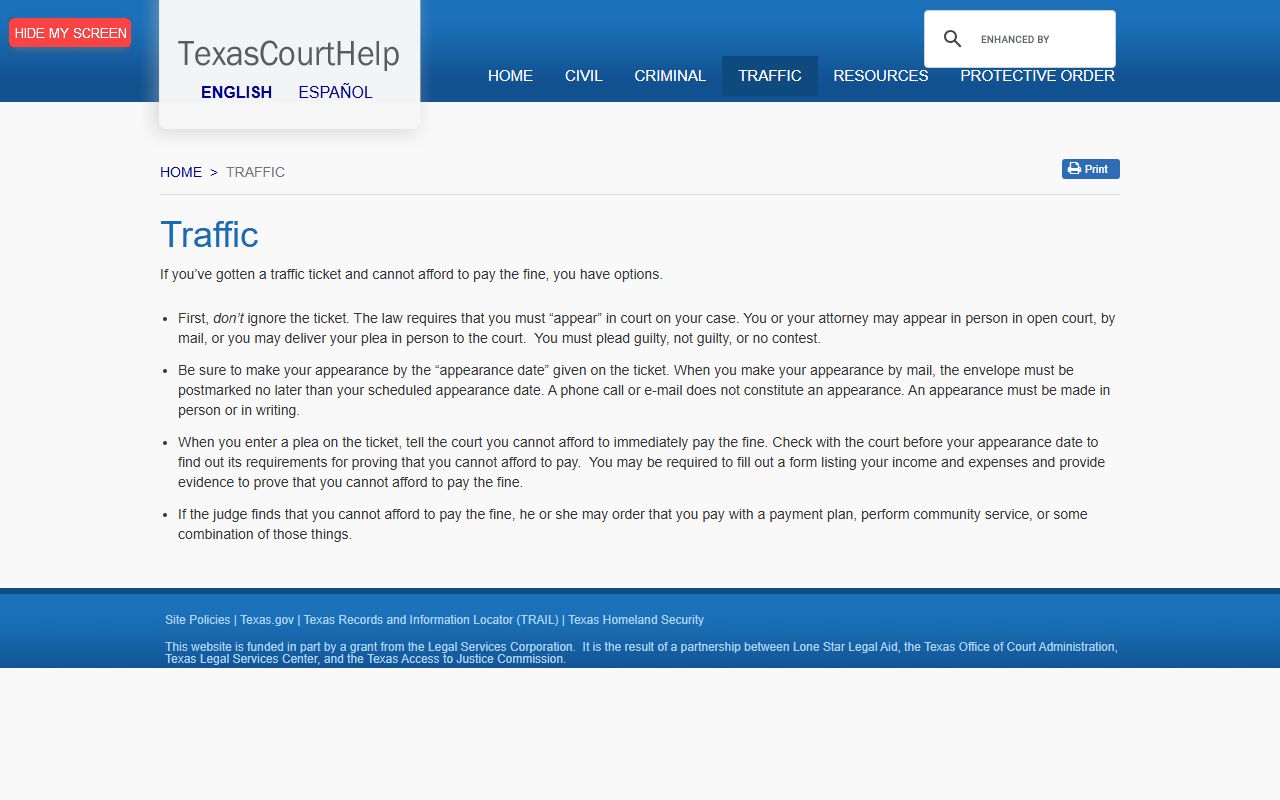
The TexasCourtHelp.gov traffic section explains plea options, appearance requirements, and what to do if you cannot afford to pay a fine.
Responding to a Texas Traffic Ticket
When you get a traffic ticket in Texas, you have to appear in court by the date listed on the citation. Texas law requires that you plead guilty, not guilty, or no contest. You can appear in person in open court, by mail, or by having an attorney appear for you. A phone call or email does not count as an appearance. This rule applies whether you want to fight the ticket or just pay the fine.
If you cannot pay the fine, the court may set up a payment plan or order community service. You may need to fill out a form listing your income and expenses to show that you qualify for reduced payment options. TexasCourtHelp.gov walks through all of these options in plain language.
For eligible violations, you may be able to take a Driver Safety Course (DSC) to get the charge dismissed. To qualify, you typically need to plead guilty or no contest, pay a set of court fees including an administrative fee, and request the DSC on or before your court date. You then have 90 days to complete the course and submit a certified copy of your driving record from DPS. The certified driving record costs $10 by mail or $12 online. CDL holders are not eligible for DSC dismissals.
Deferred disposition is another option in some Texas courts. The judge defers a finding of guilt for a set period. If you meet the conditions set by the court during that time, the charge gets dismissed. Both DSC and deferred disposition keep the violation off your driving record, which matters for insurance and licensing purposes.

The Texas Judicial Branch website links to court directories, rules, and resources for navigating the Texas court system.
Texas Traffic Laws and Statutes
Most Texas traffic laws live in the Transportation Code. Transportation Code Chapter 542 is called the Uniform Act Regulating Traffic on Highways. It sets general rules for traffic enforcement, including provisions about motor vehicle records and their release. Section 542.302 specifically makes motor vehicle records open to inspection, which is why traffic court records are considered public in Texas.
Transportation Code Chapter 543 covers uniform citation and complaint forms. This is the law that governs how citations are written, issued, and recorded. Section 543.005 requires courts to keep records of traffic citations. These records are what you find when you search a court's case database for a traffic violation.
The Texas Public Information Act, Government Code Chapter 552, governs public access to government records broadly. Under this law, court records including traffic case filings are generally available to the public. Agencies have up to 10 business days to respond to a public information request. If a government body believes a record is confidential, it must seek a ruling from the Texas Attorney General's office.
Driver license records fall under Transportation Code Chapter 521. Section 521.292 addresses public access to DPS driver records. The DPS maintains your driving history, including any traffic conviction entered by a Texas court. The court clerk sends conviction data to DPS, which updates your record. Texas does not use a point system in the same way other states do; instead, the Driver Responsibility Program (repealed in 2019) was replaced by a focus on surcharges for certain offenses that have since been eliminated.
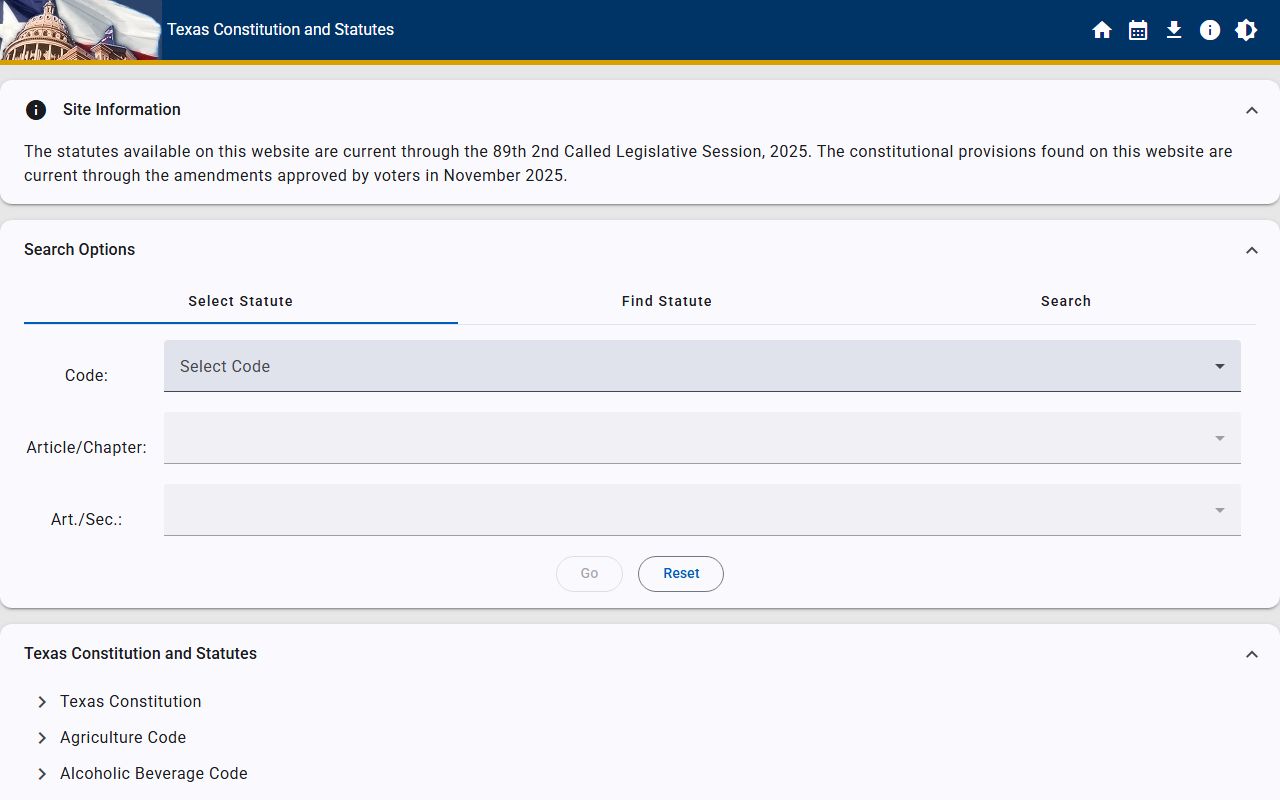
The Texas Constitution and Statutes website gives you free access to the full text of the Transportation Code and all other Texas laws.
Texas DPS Driver Records
The Texas Department of Public Safety maintains driver records for all licensed Texas drivers. Your DPS driver record shows convictions from Texas courts, license status, suspensions, and any other actions taken against your driving privileges. This is separate from the court case record, which lives with the clerk of the court where the case was heard.
You can request your own Texas DPS driver record online for $12. Requests by mail cost $10 and take 14 to 21 days. The mail form is DR-1 or DR-36, sent to DPS, Attn: L:R, PO Box 149008, Austin TX 78714-9008. Online records must be printed when viewed; Texas DPS will not mail you a copy of an online record. Certified driving records from Texas DPS are required if you want to take a Driver Safety Course for ticket dismissal.
Commercial users with permissible use can access Texas DPS records through an electronic access agreement. Bulk Texas driver license data is available (names, addresses, dates of birth) for $2,000 for the full file or $75 for weekly updates. Driver history is not included in bulk data. Contact DPS Commercial Services at 512-424-5967 for Texas license agreements.
The Texas DPS website is where you request driver records, check license status, and find information about the Texas Highway Patrol.
Texas Court Forms and E-Filing
eFileTexas.gov is the official e-filing system for all Texas courts. Mandatory e-filing applies to attorneys in civil, family, probate, and criminal cases at district and county courts. Some JP courts also allow e-filing. Non-attorney filers are encouraged to use the system but are not required to do so for traffic cases.
The TOPICs system (Texas Online Public Information - Courts) is where courts post local rules, forms, standing orders, and citations. Effective January 1, 2023, Texas courts must post local rules and forms to TOPICs to make them effective. If you need local court forms for a specific JP court or municipal court, TOPICs is the place to check. You can search by court name or county.
The OCA Rules and Forms page has statewide court rules and standards. It also links to the local rules database. If you have a complaint that a local rule conflicts with state law or is unfair, you can submit it in writing to the presiding judge of the administrative judicial region.
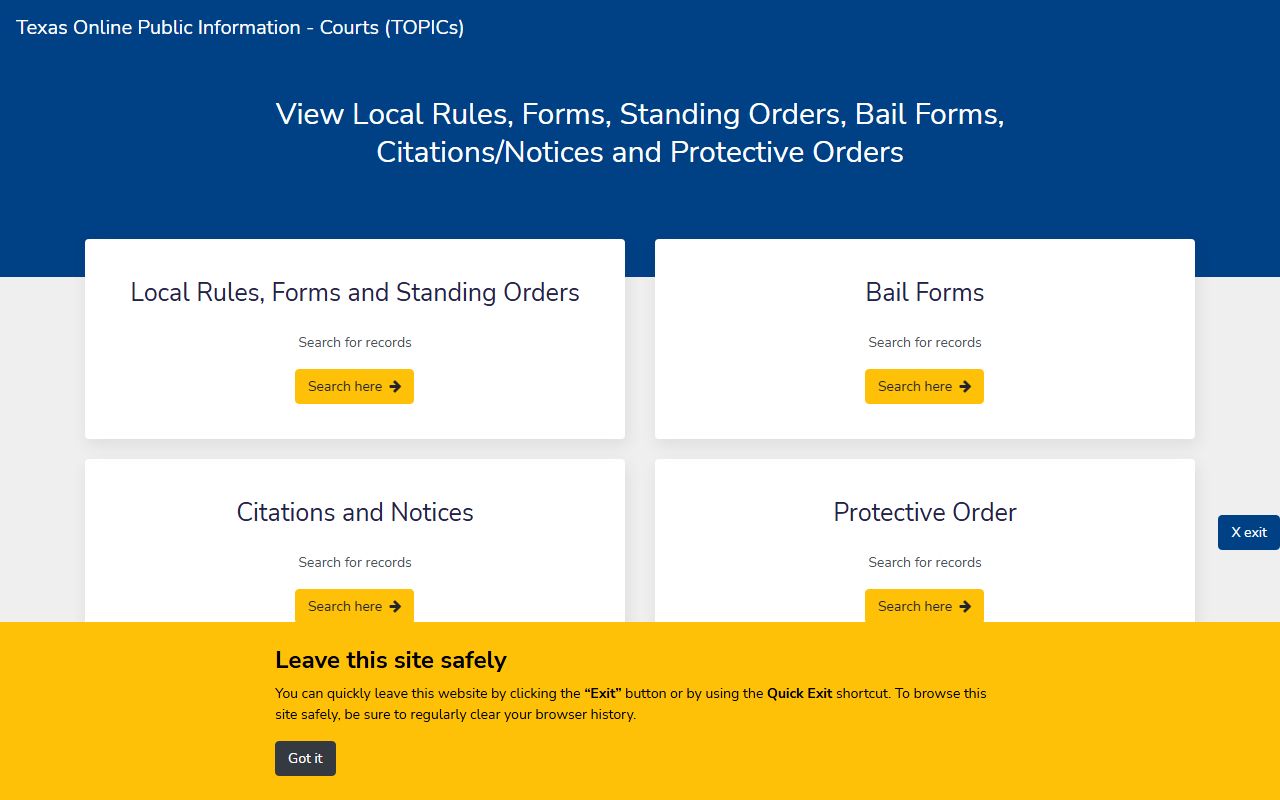
The TOPICs portal holds local court rules, traffic forms, and standing orders from courts across all 254 Texas counties.
Are Texas Traffic Court Records Public
Yes. Traffic court records in Texas are generally public under the Texas Public Information Act and the rules governing judicial records. You do not need to be a party to the case to request copies. Anyone can walk into a JP court or municipal court and ask for records. You do not need to give a reason.
Some records may have restricted access. Juvenile traffic cases are not public. Records that have been expunged or sealed are not available. Records involving certain personal information like social security numbers and financial account numbers get redacted from public documents. Beyond those exceptions, the case file, citation, judgment, and payment records are open.
The Texas Attorney General's office handles rulings when a government body tries to withhold requested records. If a court clerk refuses your request, you can contact the OAG's open records division. The TxDMV open records page covers how to request vehicle-related records from the DMV, which is separate from court records but related to traffic matters.
Note: Juvenile traffic cases and expunged records are not public. All other traffic court case files are generally open to anyone who requests them.

The Texas Attorney General website explains your rights under the Public Information Act and how to appeal a denial of records.
Texas Vehicle and DMV Records
Texas traffic court records and vehicle records are maintained by different agencies. Vehicle title and registration records are at the Texas Department of Motor Vehicles. To request title history or registration records in Texas, you need to complete Form VTR-275 and mail it with a copy of your ID and payment to TxDMV. The mailing address is: Open Records, Office of General Counsel, Texas Department of Motor Vehicles, 4000 Jackson Avenue, Austin, TX 78731.
Texas driver license records go to DPS, not TxDMV. TxDMV does not maintain Texas driver histories or traffic conviction records. Crash records and road conditions go to TxDOT. Each Texas agency handles its own piece of the puzzle. Make sure you are going to the right place for what you need.
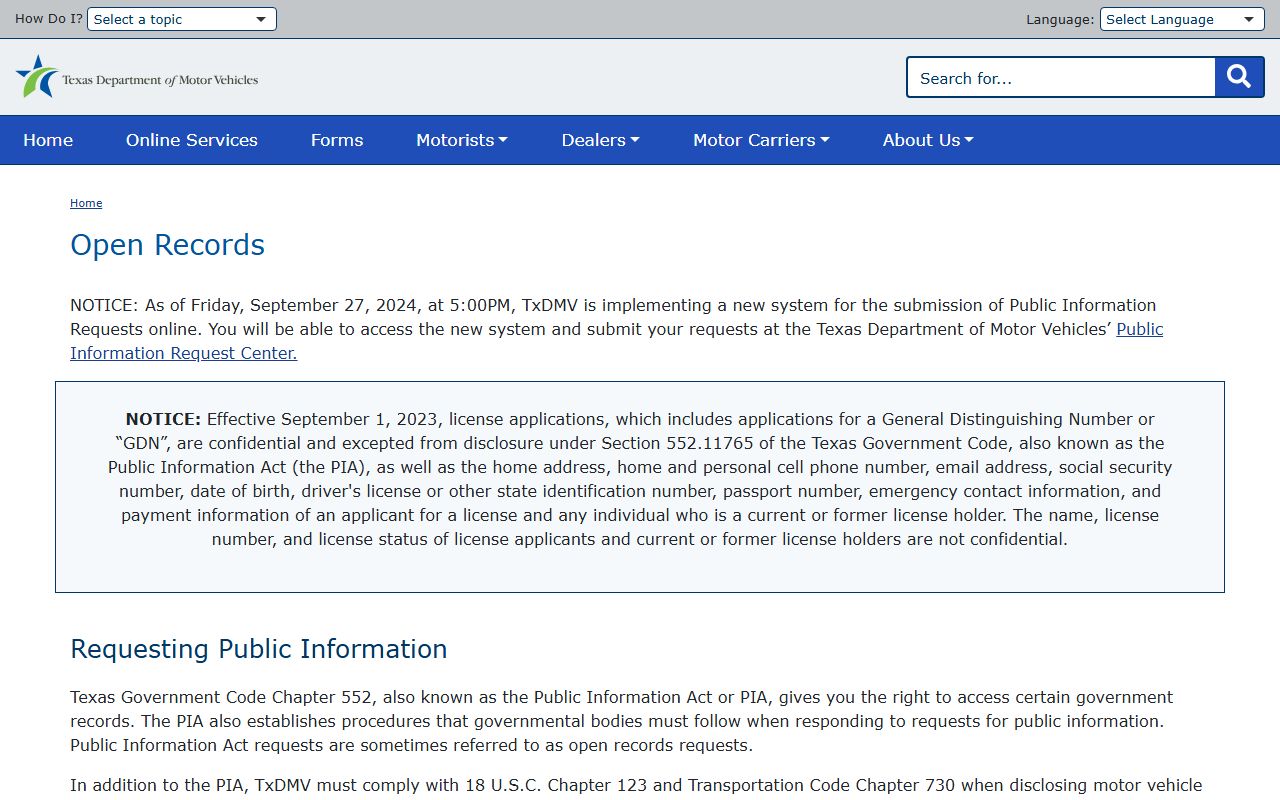
The TxDMV open records page explains how to request motor vehicle title and registration records using Form VTR-275.
Browse Texas Traffic Court Records by Location
Each of Texas's 254 counties has its own JP courts and county courts handling traffic cases. Select a county below to find local court contact information and resources.
Traffic Court Records in Major Texas Cities
Residents of major Texas cities deal with municipal courts for traffic tickets issued within city limits. Pick a city below to find where to go for records in that area.